Air-Core Shunt Reactor: The Invisible Guardian of Grid Safety
更新时间:2026-05-04 19:41:17•点击:458 • Industry Views
1. Product Overview
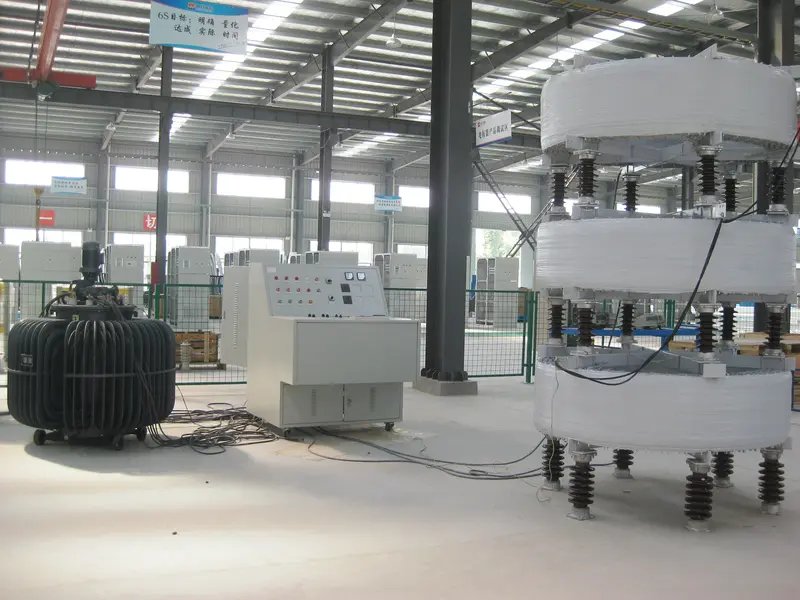
The air-core shunt reactor is an essential reactive power compensation device in power systems. Connected in parallel to transmission lines or busbars, it compensates for line capacitive charging power, limits power frequency overvoltage and switching overvoltage, and improves power system stability and power quality. Compared with iron-core shunt reactors, the air-core design eliminates saturation issues, maintaining constant inductance across the entire voltage range with excellent linearity. RECON Power Technology specializes in the R&D and manufacturing of dry-type air-core reactors, serving power transmission, renewable energy integration, and industrial distribution sectors.
2. Application Scenarios
2.1 EHV/UHV Transmission Line Reactive Compensation
EHV and UHV transmission lines have significant distributed capacitance, generating substantial capacitive charging power under light load or no-load conditions, causing voltage rise at line ends. Connecting air-core shunt reactors at transmission line terminals or intermediate stations effectively absorbs capacitive reactive power, controls voltage within reasonable limits, and limits switching and temporary overvoltages.
2.2 Substation Busbar Voltage Control
Air-core shunt reactors connected to substation busbars absorb excess reactive power during light load conditions, preventing overvoltage. Combined with capacitor banks, they enable flexible reactive power regulation. RECON dry-type air-core shunt reactors are oil-free with no leakage risk, suitable for both indoor and outdoor installation with minimal maintenance requirements.
2.3 Renewable Energy Integration
Wind and solar power plants connect to the grid through long transmission lines, where line capacitive charging issues are more pronounced. The fluctuating nature of renewable generation causes frequent voltage variations. Installing air-core shunt reactors at renewable energy collection stations effectively absorbs capacitive reactive power and suppresses voltage fluctuations, meeting grid connection requirements.
2.4 Cable Line Reactive Compensation
Power cables have significantly higher distributed capacitance than overhead lines, making capacitive charging issues more severe. In urban distribution networks with extensive cable usage, connecting shunt reactors at cable line terminals effectively absorbs capacitive reactive power, prevents voltage rise, and extends cable insulation life.
2.5 Switching Overvoltage Limitation
Transmission line switching operations generate overvoltages, particularly during auto-reclosing cycles where overvoltage levels may exceed 2.5 times normal. Shunt reactors effectively reduce the magnitude and steepness of switching overvoltages, protecting transformers, circuit breakers, and surge arresters. Air-core shunt reactors maintain excellent linear characteristics under overvoltage conditions without saturation.
3. Technical Advantages
3.1 Dry-Type Air-Core Design
RECON air-core shunt reactors adopt a dry-type air-core structure. The coreless design eliminates saturation issues, maintaining constant inductance from normal to maximum operating voltage with excellent linearity. Compared with oil-immersed shunt reactors, the dry-type design eliminates oil leakage risks, requires no periodic maintenance, and offers significantly lower operating costs. The dry-type structure also avoids partial discharge issues associated with oil-paper insulation.
3.2 High-Quality Insulation System
The products utilize Class F or Class H epoxy resin impregnated fiberglass wound insulation systems with superior insulation performance. Partial discharge levels are controlled below 10 pC. Vacuum pressure impregnation ensures complete filling of winding gaps without voids, providing a thermal aging life exceeding 30 years. All products undergo rigorous turn-to-turn insulation tests and power frequency withstand voltage tests before delivery.
3.3 Low Loss Design
Through optimized conductor cross-section and improved transposition techniques, eddy current and stray losses are effectively reduced, with product losses below national standard specified values. For a typical 10 Mvar rated product, three-phase total losses are approximately 15 to 25 kW, delivering significant energy savings over long-term operation. The low loss design also reduces temperature rise, extending insulation life.
3.4 Low Vibration and Low Noise
Optimized winding structure and fixation methods, combined with advanced vibration damping design, ensure low vibration and low noise operation, with noise levels controlled below 60 dB(A). Special noise reduction designs are available for applications with stricter noise requirements.
3.5 Custom Design Capability
RECON offers customized design based on specific customer requirements including rated capacity (1 Mvar to 100 Mvar), rated voltage (6 kV to 220 kV), mounting orientation, connection configuration, and noise level. All products are type-tested by nationally accredited testing authorities with complete type test reports provided.
4. Technical Specifications
BKXKL series dry-type air-core shunt reactor typical parameters: rated capacity 1 Mvar to 100 Mvar, rated voltage 6 kV to 220 kV, rated reactance 100 Ω to 5000 Ω, quality factor ≥50, thermal class F or H, noise level ≤60 dB(A), partial discharge ≤10 pC, ambient temperature -40°C to +55°C, mounting vertical or horizontal.
5. Conclusion
Air-core shunt reactors play an indispensable role in modern power systems. From EHV transmission to renewable energy integration, from urban cable networks to industrial distribution, their applications continue to expand. RECON Power Technology, with deep electromagnetic design expertise and rigorous quality control, delivers high-performance and high-reliability shunt reactor products to support safe and stable power system operation.
Recommended Reading
-
Air-Core Shunt Reactor: The Invisible Guardian of Grid Safety
2026-05-04 19:41:17•458 次
-
HV Air-Core Current-Limiting Reactor: Applications and Technical Advantages
2026-05-04 18:11:58•447 次
-
Recon Launches High-Capacity Core Series Reactor (10kV) for Reactive Power Compensation
2026-05-03 13:34:26•386 次
-
Recon Showcases dv/dt Output Filter at 2026 China Paper Industry Digitalization Summit
2026-05-03 12:54:49•380 次


